Omicron Persei Cloud (IC 348)
Omicron Persei Cloud (IC 348) is a cluster + nebula in the constellation Perseus, 10′ × 10′ across.
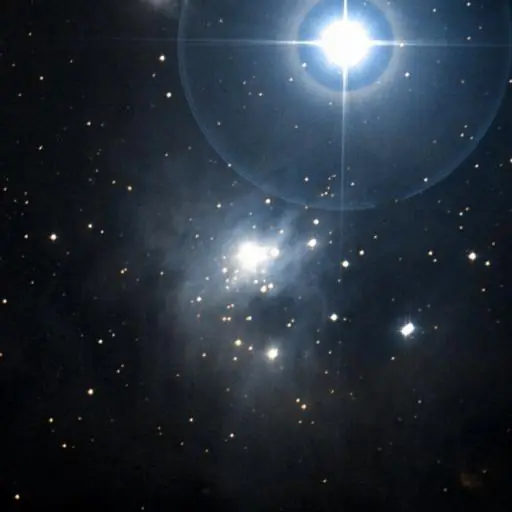
A young star cluster in Perseus where the Webb telescope found some of the lightest free-floating brown dwarfs known.
A few million years ago, roughly 400 stars were born here, inside the Perseus molecular cloud. They are still so young that about half are wrapped in the dusty discs from which planets form. IC 348 is a relatively close star-forming region, which lets astronomers hunt for the faintest, lightest objects born in it.
In 2023 the James Webb Space Telescope found brown dwarfs here weighing just three or four times as much as Jupiter, among the smallest free-floating ones on record. Objects that light blur the line between stars and planets.
Omicron Persei Cloud (IC 348) is 1,000 light-years away: the light we see from it set off around 1030, around the time Chinese astronomers recorded the supernova that made the Crab Nebula.
Did you know?
- The amino acid that wasn’t. In 2023 researchers claimed to have found tryptophan, an amino acid, in IC 348’s gas. Later Webb observations and better laboratory data showed the signal came from instrument artefacts.
How big is it?
Born about 12 million years ago, when great apes were spreading through Africa and Europe. Light itself takes 2.9 years to cross it. Gaia has picked out 302 stars moving together through space as its members. That’s 3,060 Solar Systems side by side. Shrink our Solar System — the Sun and all eight planets — to the size of a coin, and the Omicron Persei Cloud would be 73.4 m across (about the length of a football pitch); the nearest star would be a football pitch away, and the Milky Way 2,520 km across.
A star cluster with nebulosity in Perseus, about 10′ across.
When and where to see it
It is best placed in the evening sky around December, when it crosses the meridian at about 10 pm local time (around midnight in November). It can be seen from everywhere north of 58°S and never sets north of 58°N.
At its highest it stands 72° up from 50°N, 87° up from 35°N, 58° up from the equator, 23° up from 35°S.
Facts
- Type
- Cluster + nebula
- Constellation
- Perseus
- Designations
- IC 348, IC 1985
- Apparent size
- 10′ × 10′
- Position
- RA 3h 44.6m, Dec +32° 10′ (J2000)
- Distance
- 1,000 light-years
Open AstroPilot to see when Omicron Persei Cloud (IC 348) is highest tonight from your location, how easy it is with your telescope or binoculars, and an eyepiece view.