Lambda Centauri Nebula (IC 2944)
Lambda Centauri Nebula (IC 2944) is a cluster + nebula in the constellation Centaurus, magnitude 4.5 (blue), 1.3° across.
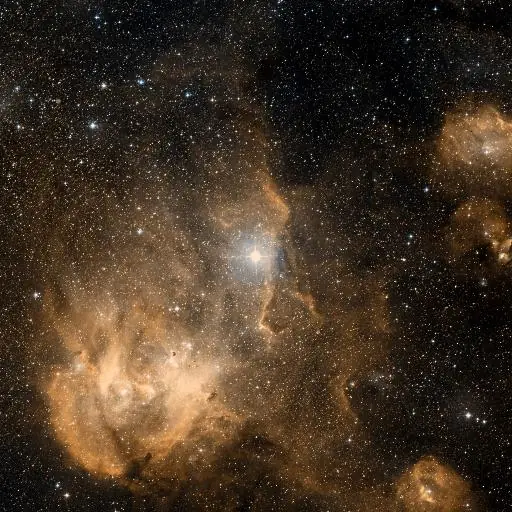
Dark globules drifting against glowing gas — and a pattern of stars said to look like a running chicken.
Small, dark, ragged blobs float against the glowing gas of IC 2944, like drops of ink on a lit screen. A. David Thackeray spotted them in 1950, and they are now called Thackeray’s Globules: dense clouds of cold gas and dust, silhouetted against the light behind.
Dark globules like these, known as Bok globules, are often places where new stars are being born. Here, so far, none shows any sign of it. Instead they are being worn away by the fierce light of the hot young stars in this cluster and nebula.
The region has a sillier name too. A group of its stars is said to resemble a running chicken, so it is also known as the Running Chicken Nebula. Lambda Centauri, which lends it its other name, actually lies just outside.
Lambda Centauri Nebula (IC 2944) is 7,700 light-years away: the light we see from it set off around 5680 BC, around the time the first towns were growing in the Fertile Crescent.
Did you know?
- Stars in the shadows. Infrared images from the 2MASS survey show six stars within the largest of Thackeray’s Globules — though no sign has been found that any are forming there.
- Three nebulae in one. What looks like one cloud in photographs is several catalogue entries: IC 2944 is the cluster and its glow stretching towards Lambda Centauri, while the brighter patch to the south-east is IC 2948.
How big is it?
40 times the distance from the Sun to the nearest star. Light itself takes 168 years to cross it. Gaia has picked out 25 stars moving together through space as its members. Shrink our Solar System — the Sun and all eight planets — to the size of a coin, and the Lambda Centauri Nebula would be 4.24 km across (an hour’s walk); the nearest star would be a football pitch away, and the Milky Way 2,520 km across.
A young star cluster and emission nebula near Lambda Centauri, known for the small dark Thackeray's globules seen against it in photographs.
When and where to see it
It is best placed in the evening sky around April, when it crosses the meridian at about 10 pm local time (around midnight in March). It can be seen from everywhere south of 27°N and never sets south of 27°S.
At its highest it stands below the horizon from 50°N, below the horizon from 35°N, 27° up from the equator, 62° up from 35°S.
Facts
- Type
- Cluster + nebula
- Constellation
- Centaurus
- Designations
- IC 2944, C 100, Running Chicken Nebula
- Magnitude
- 4.5 (blue)
- Apparent size
- 1.3°
- Position
- RA 11h 35.8m, Dec −63° 1′ (J2000)
- Distance
- 7,700 light-years
- Discovered
- Royal Harwood Frost, 1904
Open AstroPilot to see when Lambda Centauri Nebula (IC 2944) is highest tonight from your location, how easy it is with your telescope or binoculars, and an eyepiece view.