Southern Pleiades (IC 2602)
Southern Pleiades (IC 2602) is an open cluster in the constellation Carina, magnitude 1.9, 48′ across.
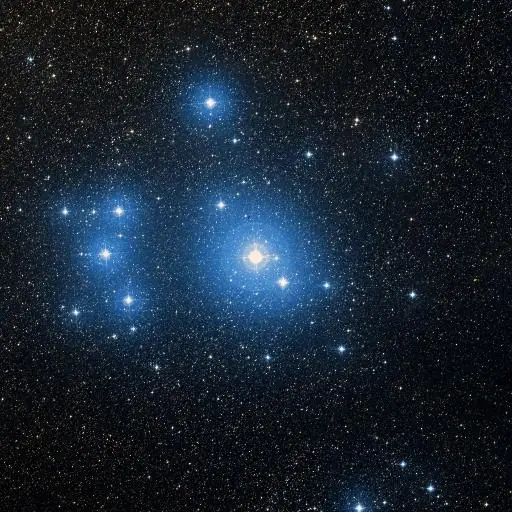
The third-brightest star cluster in the sky — the southern answer to the Pleiades.
The north has its Pleiades; the south has a sister. On 3 March 1751, at the Cape of Good Hope, the Abbé Lacaille noted a bright star in the great ship Argo Navis surrounded by a swarm of fainter ones, and remarked how much the group resembled the Pleiades. The comparison has stuck: this is the Southern Pleiades.
Among open clusters, only the Hyades and the Pleiades themselves outshine it. Its roughly 75 stars are young — probably around 50 million years old, though one method gives an even younger age — and the cluster belongs to a much larger family of young stars, the Lower Scorpius–Centaurus association.
Its brightest member, Theta Carinae, is a hot blue star. Another, p Carinae, lies well outside the main group and varies slightly in brightness.
Southern Pleiades (IC 2602) is 490 light-years away: the light we see from it set off around 1535, around the time Copernicus put the Sun at the centre of the Solar System.
Did you know?
- The ship that was broken up. Lacaille knew Theta Carinae as Theta Navis, in the giant ship Argo Navis. He later split that unwieldy constellation into three: Carina the keel, Puppis the stern and Vela the sails.
- The Diamond Cross. Theta Carinae is part of the Diamond Cross, a pattern of stars often mistaken for the real Southern Cross in Crux.
- A planet of known age. An exoplanet has been found orbiting TOI-837, one of the cluster’s young stars — a planet whose age we know, because we know the cluster’s.
How big is it?
Born about 36 million years ago, when the Himalayas and the Alps were rising. Light itself takes 6.8 years to cross it. Gaia has picked out 638 stars moving together through space as its members. That’s 1.6 times the distance from the Sun to the nearest star. Shrink our Solar System — the Sun and all eight planets — to the size of a coin, and the Southern Pleiades would be 173 m across (2 football pitches end to end); the nearest star would be a football pitch away, and the Milky Way 2,520 km across.
A bright open cluster around Theta Carinae, visible to the naked eye and resembling the Pleiades; best in binoculars.
When and where to see it
It is best placed in the evening sky around April, when it crosses the meridian at about 10 pm local time (around midnight in February). It can be seen from everywhere south of 26°N and never sets south of 26°S.
At its highest it stands below the horizon from 50°N, below the horizon from 35°N, 26° up from the equator, 61° up from 35°S.
Facts
- Type
- Open cluster
- Constellation
- Carina
- Designations
- IC 2602, C 102, Mel 102, Cr 229, Theta Carinae Cluster, Melotte 102, Collinder 229
- Magnitude
- 1.9
- Apparent size
- 48′
- Position
- RA 10h 43.0m, Dec −64° 24′ (J2000)
- Distance
- 490 light-years
- Discovered
- Nicolas-Louis de Lacaille, 1751
Open AstroPilot to see when Southern Pleiades (IC 2602) is highest tonight from your location, how easy it is with your telescope or binoculars, and an eyepiece view.