IC 2553
IC 2553 is a planetary nebula in the constellation Carina, magnitude 10.3, 9″ across.
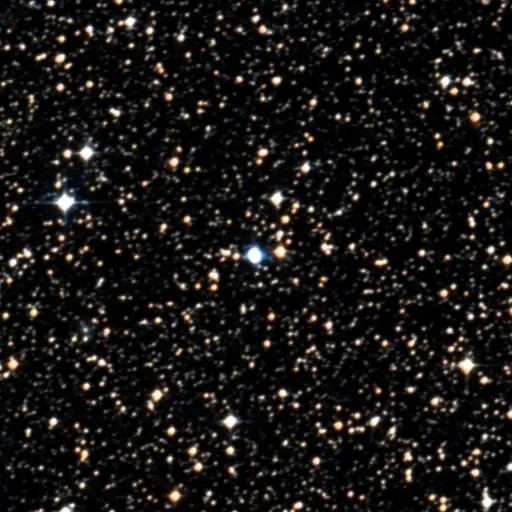
A small planetary nebula in the keel of the ancient ship Argo, now the constellation Carina.
Carina is the keel of a ship. It was once part of Argo Navis, the vast constellation of Jason’s ship, until the 18th-century French astronomer Nicolas-Louis de Lacaille divided it into keel, stern and sails. IC 2553 lies in the keel. It is a planetary nebula: the glowing gas a dying star threw off as it ran out of fuel. The star left at its centre is a small, hot core that will end its days as a white dwarf.
IC 2553 is 12,000 light-years away: the light we see from it set off about 12,000 years ago, when the last Ice Age was ending.
How big is it?
551 Solar Systems side by side. Light itself takes 6 months to cross it. Shrink our Solar System — the Sun and all eight planets — to the size of a coin, and IC 2553 would be 13.2 m across (about the length of a bus); the nearest star would be a football pitch away, and the Milky Way 2,520 km across.
A 10.3-magnitude planetary nebula in Carina, about 9″ across. Its central star is magnitude 15.5.
When and where to see it
It is best placed in the evening sky around March, when it crosses the meridian at about 10 pm local time (around midnight in February). It can be seen from everywhere south of 27°N and never sets south of 27°S.
At its highest it stands below the horizon from 50°N, below the horizon from 35°N, 27° up from the equator, 62° up from 35°S.
Facts
- Type
- Planetary nebula
- Constellation
- Carina
- Designations
- IC 2553
- Magnitude
- 10.3
- Apparent size
- 9″
- Position
- RA 10h 9.3m, Dec −62° 37′ (J2000)
- Distance
- 12,000 light-years
Open AstroPilot to see when IC 2553 is highest tonight from your location, how easy it is with your telescope or binoculars, and an eyepiece view.