IC 2488 (Mel 97)
IC 2488 (Mel 97) is an open cluster in the constellation Vela, magnitude 7.4, 7.2′ across.
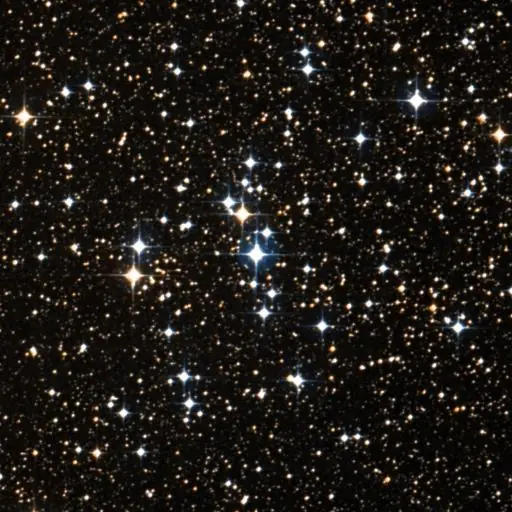
A Vela cluster first logged by Lacaille in 1752 — and catalogued again and again over the next 150 years.
On 25 January 1752, during his expedition to South Africa, the French astronomer Nicolas-Louis de Lacaille recorded this open cluster as entry III.4 in his southern catalogue. James Dunlop saw it again from Australia in 1826, describing a faint cluster with two or three fairly bright stars. Only in 1908 did it receive its IC number, using a position Solon Bailey had measured on photographs taken at Arequipa in Peru.
IC 2488 (Mel 97) is 4,300 light-years away: the light we see from it set off around 2280 BC, 290 years after the Great Pyramid of Giza was completed.
Did you know?
- A bigger family than it looks. Studies count about 370 probable member stars, including three blue stragglers and at least three red giants, one of them a spectroscopic binary.
How big is it?
Born about 160 million years ago, when dinosaurs were rising and the supercontinent Pangaea was breaking apart. Light itself takes 9 years to cross it. Gaia has picked out 510 stars moving together through space as its members. That’s 2.1 times the distance from the Sun to the nearest star. Shrink our Solar System — the Sun and all eight planets — to the size of a coin, and IC 2488 would be 227 m across (2 football pitches end to end); the nearest star would be a football pitch away, and the Milky Way 2,520 km across.
A 7.4-magnitude open cluster in Vela, about 7.2′ across.
When and where to see it
It is best placed in the evening sky around March, when it crosses the meridian at about 10 pm local time (around midnight in February). It can be seen from everywhere south of 33°N and never sets south of 33°S.
At its highest it stands below the horizon from 50°N, below the horizon from 35°N, 33° up from the equator, 68° up from 35°S.
Facts
- Type
- Open cluster
- Constellation
- Vela
- Designations
- Mel 97, Cr 208, Melotte 97, Collinder 208
- Magnitude
- 7.4
- Apparent size
- 7.2′
- Position
- RA 9h 27.6m, Dec −57° 0′ (J2000)
- Distance
- 4,300 light-years
- Discovered
- Nicolas-Louis de Lacaille, 1752
Open AstroPilot to see when IC 2488 (Mel 97) is highest tonight from your location, how easy it is with your telescope or binoculars, and an eyepiece view.