Browning (IC 2431)
Browning (IC 2431) is a galaxy in the constellation Cancer, magnitude 14.0, 36″ × 29″ across.
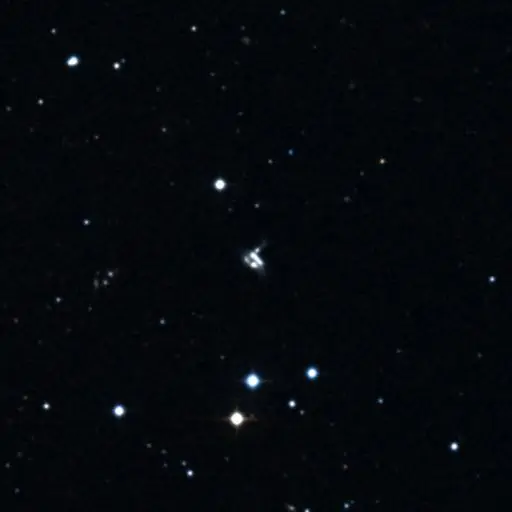
A pile-up of at least three galaxies in Cancer, tearing each other apart as they merge.
IC 2431 is a pile-up. At least three galaxies are falling together in Cancer, and as they close in, gravity is tearing each of them apart, twisting their shapes and setting off bursts of star formation. At the centre, a thick cloud of dust blocks the view, though light from a more distant galaxy peeks through its edges. Collisions like this are how big galaxies grow: the Milky Way owes much of its size to mergers of its own. Stéphane Javelle discovered the group on 24 February 1896.
Browning (IC 2431) is 680 million light-years away: the light we see from it set off about 680 million years ago, when there were no animals on Earth at all.
Did you know?
- Bright in ultraviolet. IC 2431 is also Markarian 1224, one of a catalogue of galaxies picked out for their strong ultraviolet light. It may hold an active nucleus that drives out ionised gas.
How big is it?
1.2 times as wide as our Milky Way. Light itself takes 120,000 years to cross it. Shrink it to the length of a football pitch and our whole Solar System would be smaller than a bacterium.
A 14.0-magnitude irregular galaxy (I) in Cancer, about 36″ × 29″.
When and where to see it
It is best placed in the evening sky around March, when it crosses the meridian at about 10 pm local time (around midnight in February). It can be seen from everywhere north of 75°S and never sets north of 75°N.
At its highest it stands 55° up from 50°N, 70° up from 35°N, 75° up from the equator, 40° up from 35°S.
Facts
- Type
- Galaxy
- Constellation
- Cancer
- Designations
- IC 2431
- Magnitude
- 14.0
- Apparent size
- 36″ × 29″
- Position
- RA 9h 4.6m, Dec +14° 36′ (J2000)
- Distance
- 680 million light-years
- Discovered
- Stéphane Javelle, 1896
Open AstroPilot to see when Browning (IC 2431) is highest tonight from your location, how easy it is with your telescope or binoculars, and an eyepiece view.