IC 2395 (Cr 192)
IC 2395 (Cr 192) is an open cluster in the constellation Vela, magnitude 4.6, 19′ across.
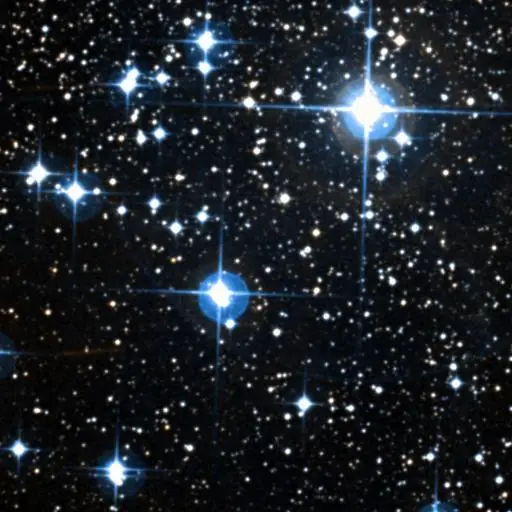
A young cluster in Vela that Lacaille may have glimpsed in 1752, then lost in catalogue confusion.
On 17 February 1752, observing from the Cape of Good Hope, Nicolas-Louis de Lacaille noted a 6th-magnitude star joined to another, more southerly one by a nebulous trail. His entry is often listed as missing, but it may well be IC 2395. Solon Bailey found the cluster again in 1908, and a misplaced position later led several star atlases to show it twice, as two different clusters.
IC 2395 is a young open cluster, between 6 and 18 million years old, and may belong to a loose association of hot, massive stars in Vela.
IC 2395 (Cr 192) is 2,300 light-years away: the light we see from it set off around 280 BC, 165 years after the Parthenon was dedicated in Athens.
Did you know?
- A pulsing member. One of its stars, HD 74339, is a Beta Cephei variable — a hot, massive star that brightens and fades slightly as it pulsates.
How big is it?
Born about 20 million years ago, when the Himalayas and the Alps were rising. Light itself takes 12 years to cross it. Gaia has picked out 745 stars moving together through space as its members. That’s 2.9 times the distance from the Sun to the nearest star. Shrink our Solar System — the Sun and all eight planets — to the size of a coin, and IC 2395 would be 314 m across (3 football pitches end to end); the nearest star would be a football pitch away, and the Milky Way 2,520 km across.
A 4.6-magnitude open cluster in Vela, about 19′ across.
When and where to see it
It is best placed in the evening sky around February, when it crosses the meridian at about 10 pm local time (around midnight in January). It can be seen from everywhere south of 42°N and never sets south of 42°S.
At its highest it stands below the horizon from 50°N, 7° up from 35°N, 42° up from the equator, 77° up from 35°S.
Facts
- Type
- Open cluster
- Constellation
- Vela
- Designations
- Cr 192, Collinder 192
- Magnitude
- 4.6
- Apparent size
- 19′
- Position
- RA 8h 42.5m, Dec −48° 9′ (J2000)
- Distance
- 2,300 light-years
- Discovered
- Nicolas-Louis de Lacaille, 1752, Probably; Solon Bailey found it independently in 1908
Open AstroPilot to see when IC 2395 (Cr 192) is highest tonight from your location, how easy it is with your telescope or binoculars, and an eyepiece view.