Omicron Velorum Cluster (IC 2391)
Omicron Velorum Cluster (IC 2391) is an open cluster in the constellation Vela, magnitude 2.5, 50′ across.
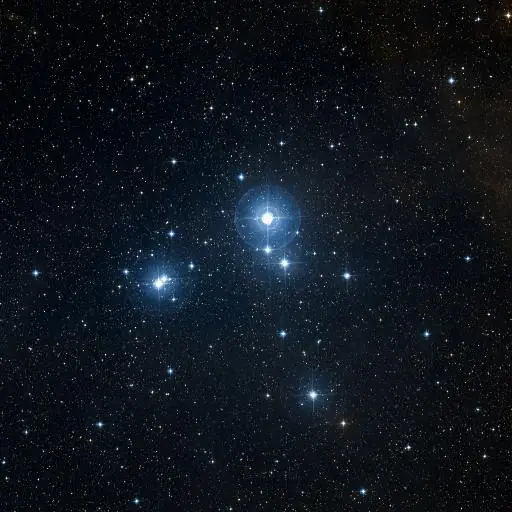
A star cluster first written down more than a thousand years ago by the Persian astronomer al-Sufi.
More than a thousand years ago, the Persian astronomer Abd al-Rahman al-Sufi noted “a nebulous star” in the southern sky, in what we now call Vela. He wrote it down around 964, more than six centuries before the first telescope.
Some eight centuries later the Abbé Lacaille found it again from the Cape of Good Hope and listed it as Lac II 5. What both men saw is an open cluster of about 30 hot, young, bluish stars, some of them in pairs.
Astronomers date it with a neat trick. Young, low-mass stars slowly destroy the lithium in their cores, and the smallest take longest. So the faintest cluster stars to have lost their lithium mark its age: for IC 2391, about 50 million years — the same era as its neighbour IC 2602, the Southern Pleiades.
Omicron Velorum Cluster (IC 2391) is 490 light-years away: the light we see from it set off around 1535, around the time Copernicus put the Sun at the centre of the Solar System.
Did you know?
- The Book of Fixed Stars. Al-Sufi’s Book of Fixed Stars is also the oldest known record of the Andromeda Galaxy, which he described as a small cloud.
- Four in one. One member of the cluster is a quadruple star: four suns bound together by gravity, born along with the rest of the cluster.
- A wider family. The cluster’s stars formed at about the same time as a nearer, scattered group called the Argus Association, which lies in the same direction of the sky.
How big is it?
Born about 29 million years ago, when the Himalayas and the Alps were rising. Light itself takes 7.1 years to cross it. Gaia has picked out 376 stars moving together through space as its members. That’s 1.7 times the distance from the Sun to the nearest star. Shrink our Solar System — the Sun and all eight planets — to the size of a coin, and the Omicron Velorum Cluster would be 180 m across (2 football pitches end to end); the nearest star would be a football pitch away, and the Milky Way 2,520 km across.
A large, bright open cluster around Omicron Velorum, visible to the naked eye and best in binoculars.
When and where to see it
It is best placed in the evening sky around February, when it crosses the meridian at about 10 pm local time (around midnight in January). It can be seen from everywhere south of 37°N and never sets south of 37°S.
At its highest it stands below the horizon from 50°N, 2° up from 35°N, 37° up from the equator, 72° up from 35°S.
Facts
- Type
- Open cluster
- Constellation
- Vela
- Designations
- IC 2391, C 85, Cr 191, Collinder 191
- Magnitude
- 2.5
- Apparent size
- 50′
- Position
- RA 8h 40.5m, Dec −53° 2′ (J2000)
- Distance
- 490 light-years
- Discovered
- Abd al-Rahman al-Sufi, 964, Described as “a nebulous star” around 964; found again by Lacaille
Open AstroPilot to see when Omicron Velorum Cluster (IC 2391) is highest tonight from your location, how easy it is with your telescope or binoculars, and an eyepiece view.