Soul Nebula (IC 1848)
Soul Nebula (IC 1848) is a cluster + nebula in the constellation Cassiopeia, magnitude 6.5, 40′ × 10′ across.
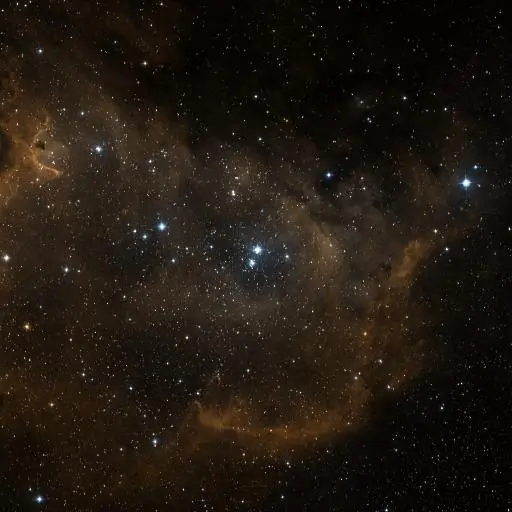
The Soul Nebula, where massive stars set off new generations of stars in waves.
Massive stars do not just light up their birth clouds — they sculpt them. In the Soul Nebula, the brightest stars have blown huge cavities in the gas. Around them, stars grow steadily younger the farther they lie from each cavity’s centre, as if the expanding edges had squeezed new stars into being. It is some of the best evidence yet for ‘triggered’ star formation.
The Soul sits beside the Heart Nebula; together they are the ‘Heart and Soul’ of Cassiopeia. IC 1848 is the cluster in its body, and lends the whole emission nebula its usual catalogue name.
Soul Nebula (IC 1848) is 6,700 light-years away: the light we see from it set off around 4680 BC, 830 years after the first towns were growing in the Fertile Crescent.
Did you know?
- Hidden galaxies. Two galaxies, Maffei 1 and Maffei 2, lie in the same part of the sky but are almost hidden by Milky Way dust. Once thought to be Local Group members, they belong to a group of their own.
How big is it?
Born about 16 million years ago, when great apes were spreading through Africa and Europe. Light itself takes 78 years to cross it. Gaia has picked out 281 stars moving together through space as its members. That’s 18 times the distance from the Sun to the nearest star. Shrink our Solar System — the Sun and all eight planets — to the size of a coin, and the Soul Nebula would be 1.97 km across (a 25-minute walk); the nearest star would be a football pitch away, and the Milky Way 2,520 km across.
A star cluster with nebulosity in Cassiopeia, about 40′ × 10′. Its catalogued magnitude, 6.5, is that of the star cluster; the nebulosity is much fainter.
When and where to see it
It is best placed in the evening sky around December, when it crosses the meridian at about 10 pm local time (around midnight in November). It can be seen from everywhere north of 30°S and never sets north of 30°N.
At its highest it stands 80° up from 50°N, 65° up from 35°N, 30° up from the equator, below the horizon from 35°S.
Facts
- Type
- Cluster + nebula
- Constellation
- Cassiopeia
- Designations
- IC 1848
- Magnitude
- 6.5
- Apparent size
- 40′ × 10′
- Position
- RA 2h 51.2m, Dec +60° 24′ (J2000)
- Distance
- 6,700 light-years
Open AstroPilot to see when Soul Nebula (IC 1848) is highest tonight from your location, how easy it is with your telescope or binoculars, and an eyepiece view.