Heart Nebula (IC 1805)
Heart Nebula (IC 1805) is a cluster + nebula in the constellation Cassiopeia, magnitude 6.5, 2.5° across.
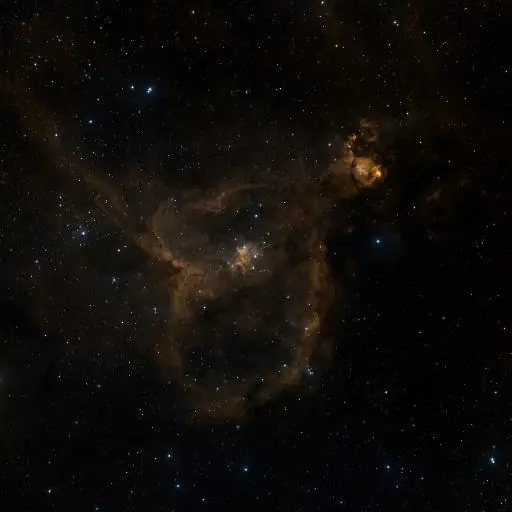
Half of the ‘Heart and Soul’: a glowing cloud shaped by stars nearly 50 times as massive as the Sun.
At the centre of the Heart Nebula sits a small cluster, IC 1805, and a few of its stars weigh nearly 50 times as much as the Sun. Their intense radiation makes the surrounding hydrogen glow red and sculpts the cloud into the shape seen in photographs — a heart to most people, a running dog to others.
William Herschel saw its brightest knot, on the western edge, on 3 November 1787; that knot still has its own number, NGC 896. In 1958 Gart Westerhout found that the nebula gives off radio waves, so it is also called Westerhout 4.
Heart Nebula (IC 1805) is 6,600 light-years away: the light we see from it set off around 4580 BC, 930 years after the first towns were growing in the Fertile Crescent.
Did you know?
- A chimney into the halo. The Heart is the brightest part of the W4 superbubble, a ‘chimney’ through which hot gas is thought to escape from the Milky Way’s disc into its halo.
How big is it?
Born about 7.6 million years ago, when our ancestors and the chimpanzees' were going their separate ways. Light itself takes 288 years to cross it. Gaia has picked out 258 stars moving together through space as its members. That’s 68 times the distance from the Sun to the nearest star. Shrink our Solar System — the Sun and all eight planets — to the size of a coin, and the Heart Nebula would be 7.27 km across (a 1-hour walk); the nearest star would be a football pitch away, and the Milky Way 2,520 km across.
A star cluster with nebulosity in Cassiopeia, about 2.5° across. Its catalogued magnitude, 6.5, is that of the star cluster; the nebulosity is much fainter.
When and where to see it
It is best placed in the evening sky around December, when it crosses the meridian at about 10 pm local time (around midnight in November). It can be seen from everywhere north of 29°S and never sets north of 29°N.
At its highest it stands 79° up from 50°N, 64° up from 35°N, 29° up from the equator, below the horizon from 35°S.
Facts
- Type
- Cluster + nebula
- Constellation
- Cassiopeia
- Designations
- IC 1805
- Magnitude
- 6.5
- Apparent size
- 2.5°
- Position
- RA 2h 32.7m, Dec +61° 27′ (J2000)
- Distance
- 6,600 light-years
- Discovered
- William Herschel, 1787, He saw its brightest knot, now catalogued as NGC 896
Open AstroPilot to see when Heart Nebula (IC 1805) is highest tonight from your location, how easy it is with your telescope or binoculars, and an eyepiece view.