IC 1613 (C 51)
IC 1613 (C 51) is a galaxy in the constellation Cetus, magnitude 9.5, 18′ × 17′ across.
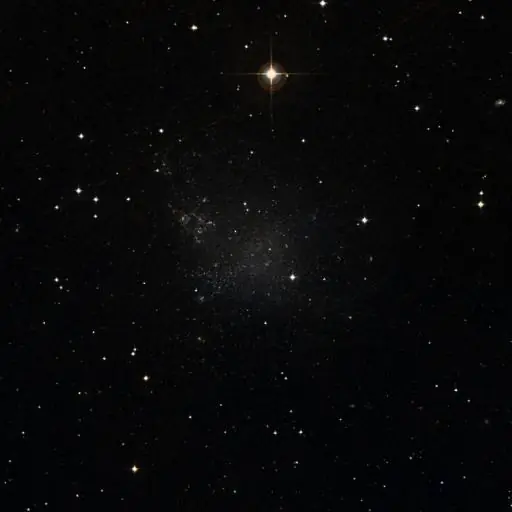
A dust-free dwarf galaxy that became a testing ground for measuring the universe.
A galaxy with almost no dust is a gift to astronomers. IC 1613, a faint dwarf on the outskirts of the Local Group, is unusually clean: there is little dust inside it, and little along our line of sight. Its stars shine through undimmed, so their brightness is easy to read.
That made it a key testing ground for the Cepheid period–luminosity rule, the yardstick used to measure the universe. It also holds RR Lyrae stars — rare in a dwarf irregular galaxy — which provide a second, independent check. Together they allow especially accurate distance estimates. Most of its stars are around 7 billion years old, though some are far older.
Max Wolf, the Heidelberg pioneer of astrophotography, discovered it in 1906.
IC 1613 (C 51) is 2.3 million light-years away: the light we see from it set off about 2.3 million years ago, when our distant ancestors were making the first stone tools.
Did you know?
- A young supernova remnant. Allan Sandage noted a glowing cloud here in 1971 using the 200-inch Hale telescope. Now called S8, it is the wreck of a star that exploded only some 2,700 to 4,400 years ago.
- A rare kind of star. It holds DR1, a WO star — an extremely hot, rare kind of Wolf–Rayet star — which may be the only Wolf–Rayet star in the whole galaxy.
- Its first nova. In 1999 astronomers caught the first nova ever detected in IC 1613: a white dwarf flaring up as it pulls in gas from a companion star.
How big is it?
12% of the Milky Way’s width. Light itself takes 12,000 years to cross it. Shrink it to the length of a football pitch and our whole Solar System would be about the size of a red blood cell.
A dwarf irregular galaxy in the Local Group, very faint and diffuse; it needs dark skies and low power.
When and where to see it
It is best placed in the evening sky around November, when it crosses the meridian at about 10 pm local time (around midnight in October). It can be seen from everywhere north of 88°S and never sets north of 88°N.
At its highest it stands 42° up from 50°N, 57° up from 35°N, 88° up from the equator, 53° up from 35°S.
Facts
- Type
- Galaxy
- Constellation
- Cetus
- Designations
- C 51
- Magnitude
- 9.5
- Apparent size
- 18′ × 17′
- Position
- RA 1h 4.8m, Dec +2° 7′ (J2000)
- Distance
- 2.3 million light-years
- Discovered
- Max Wolf, 1906
Open AstroPilot to see when IC 1613 (C 51) is highest tonight from your location, how easy it is with your telescope or binoculars, and an eyepiece view.