Harvard 21
Harvard 21 is an open cluster in the constellation Cassiopeia, magnitude 9.0, 1.8′ across.
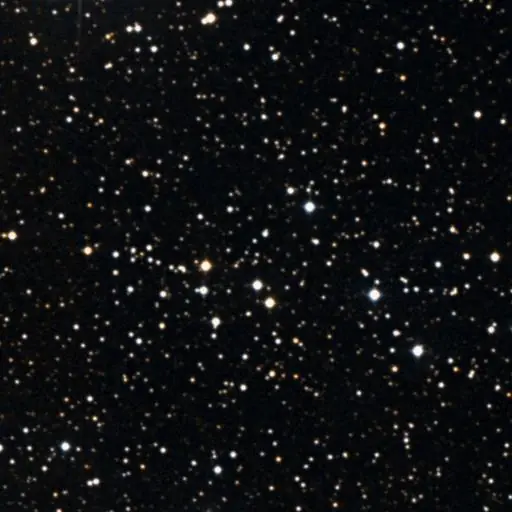
A tiny star cluster in Cassiopeia, sharing its corner of sky with NGC 7788 and NGC 7790.
Small clusters like Harvard 21 are easy to overlook among the crowded star fields of the Cassiopeia Milky Way. Its name comes from a short list of clusters drawn up at Harvard College Observatory. It shares its patch of sky with two larger clusters, NGC 7788 and NGC 7790, both within a degree. Like every open cluster, it is a group of stars that formed together from one cloud and, for now, still travel as a family.
A 9.0-magnitude open cluster in Cassiopeia, about 1.8′ across.
When and where to see it
It is best placed in the evening sky around October, when it crosses the meridian at about 10 pm local time (around midnight in September). It can be seen from everywhere north of 28°S and never sets north of 28°N.
At its highest it stands 78° up from 50°N, 63° up from 35°N, 28° up from the equator, below the horizon from 35°S.
Facts
- Type
- Open cluster
- Constellation
- Cassiopeia
- Designations
- Harvard 21
- Magnitude
- 9.0
- Apparent size
- 1.8′
- Position
- RA 23h 54.2m, Dec +61° 44′ (J2000)
Open AstroPilot to see when Harvard 21 is highest tonight from your location, how easy it is with your telescope or binoculars, and an eyepiece view.