Large Magellanic Cloud (Nubecula Major)
Large Magellanic Cloud (Nubecula Major) is a galaxy in the constellation Dorado, magnitude 0.3, 10.8° × 9.2° across.
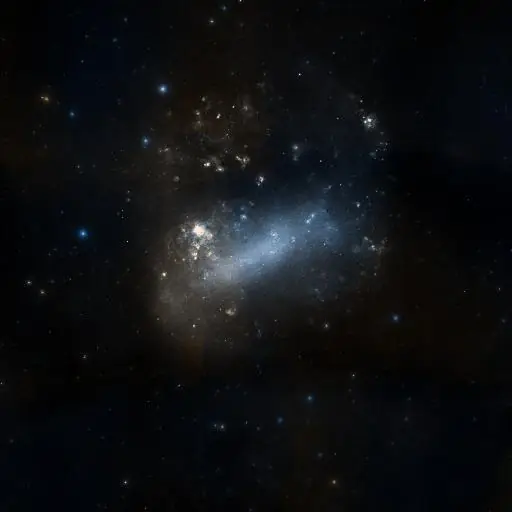
A whole galaxy hanging in the southern sky, and home to the closest supernova seen in nearly four centuries.
South of the equator, the Large Magellanic Cloud looks like a scrap torn from the Milky Way and left glowing in the dark. It is in fact a whole galaxy, a satellite of our own with about a hundredth of its mass — and still the fourth-largest galaxy in the Local Group. In about 2.4 billion years it is predicted to merge with the Milky Way.
People in the south have watched it since prehistory. The first confirmed written mention comes from Amerigo Vespucci, who in a letter of 1502 described “three Canopi, two bright and one obscure” — the two Magellanic Clouds and the dark Coalsack. Ferdinand Magellan’s voyage of 1519 made it famous in Europe, and it now bears his name.
It is a treasure-house. It holds the Tarantula Nebula, the most active star-forming region in the Local Group, along with hundreds of star clusters and planetary nebulae. In 1987 a star here exploded as Supernova 1987A, the closest supernova seen since 1604.
Large Magellanic Cloud (Nubecula Major) is 160,000 light-years away: the light we see from it set off about 160,000 years ago, when our species still lived mostly in Africa.
Did you know?
- A black hole’s slingshot. In 2025 astronomers announced strong evidence for a black hole of about 600,000 Suns at its heart — based on 21 fast stars in our galaxy’s halo that seem to have been flung out of the LMC by it.
- Named for a judge’s nose. Astronomers at Mount Stromlo named one supernova remnant, N86, after the Australian High Court judge Lionel Murphy — for his interest in science, and its supposed likeness to his large nose.
- The White Ox?. It is often said that al-Sufi recorded it around 964 as al-Bakr, the White Ox. That seems to be a misreading of his note about stars south of Canopus — stars he admitted he had never seen.
- One turn in 250 million years. Measurements with the Hubble Space Telescope in 2014 revealed how fast the LMC spins: it turns once every 250 million years or so.
How big is it?
30% of the Milky Way’s width. Light itself takes 30,000 years to cross it. Shrink it to the length of a football pitch and our whole Solar System would be about the size of a red blood cell. It holds about 20 billion stars — the Milky Way has a few hundred billion. All told — stars, gas and dark matter — it weighs about 140 billion Suns.
A 0.3-magnitude barred Magellanic spiral galaxy (SBm) in Dorado, about 10.8° × 9.2°.
When and where to see it
It is best placed in the evening sky around January, when it crosses the meridian at about 10 pm local time (around midnight in December). It can be seen from everywhere south of 20°N and never sets south of 20°S.
At its highest it stands below the horizon from 50°N, below the horizon from 35°N, 20° up from the equator, 55° up from 35°S.
Facts
- Type
- Galaxy
- Constellation
- Dorado
- Designations
- Nubecula Major
- Magnitude
- 0.3
- Apparent size
- 10.8° × 9.2°
- Position
- RA 5h 23.6m, Dec −69° 45′ (J2000)
- Distance
- 160,000 light-years
- Discovered
- Known since prehistory; first confirmed written record by Amerigo Vespucci in 1502
Open AstroPilot to see when Large Magellanic Cloud (Nubecula Major) is highest tonight from your location, how easy it is with your telescope or binoculars, and an eyepiece view.