Sculptor Dwarf Elliptical
Sculptor Dwarf Elliptical is a galaxy in the constellation Sculptor, magnitude 8.6, 40′ × 31′ across.
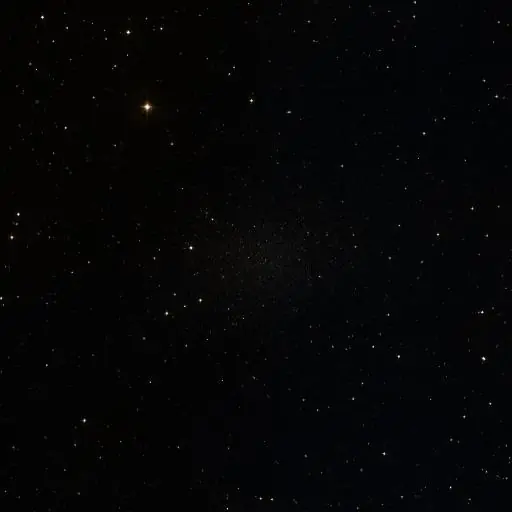
The first dwarf spheroidal galaxy ever found, home to the most metal-poor star known beyond the Milky Way.
In 1937 Harlow Shapley spotted a faint swarm of stars on plates from the Bruce telescope at Boyden Observatory in South Africa. It was the first of a new kind of galaxy: a dwarf spheroidal, a small, dim satellite orbiting the Milky Way. Its stars hold only about 4% of the heavy elements found in our galaxy, so it resembles the primitive galaxies seen at the edge of the universe. Its two distinct populations of stars may be the scars of an ancient merger with another small galaxy.
Sculptor Dwarf Elliptical is 260,000 light-years away: the light we see from it set off about 260,000 years ago, when the first Homo sapiens appeared in Africa.
Did you know?
- From the ashes of the first stars. AS0039, the most metal-poor star known outside the Milky Way, lives here. Its chemistry hints that it formed from the debris of a hypernova from one of the universe’s very first stars.
How big is it?
A dwarf beside the Milky Way. Light itself takes 3,010 years to cross it. Shrink it to the length of a football pitch and our whole Solar System would be thinner than a human hair. All told — stars, gas and dark matter — it weighs about 140 million Suns.
An 8.6-magnitude elliptical galaxy (E) in Sculptor, about 40′ × 31′.
When and where to see it
It is best placed in the evening sky around November, when it crosses the meridian at about 10 pm local time (around midnight in October). It can be seen from everywhere south of 56°N and never sets south of 56°S.
At its highest it stands 6° up from 50°N, 21° up from 35°N, 56° up from the equator, 89° up from 35°S.
Facts
- Type
- Galaxy
- Constellation
- Sculptor
- Designations
- Sculptor Dwarf Elliptical
- Magnitude
- 8.6
- Apparent size
- 40′ × 31′
- Position
- RA 1h 0.2m, Dec −33° 43′ (J2000)
- Distance
- 260,000 light-years
- Discovered
- Harlow Shapley, 1937
Open AstroPilot to see when Sculptor Dwarf Elliptical is highest tonight from your location, how easy it is with your telescope or binoculars, and an eyepiece view.