Fourcade-Figueroa
Fourcade-Figueroa is a galaxy in the constellation Centaurus, magnitude 11.7, 11′ × 1.4′ across.
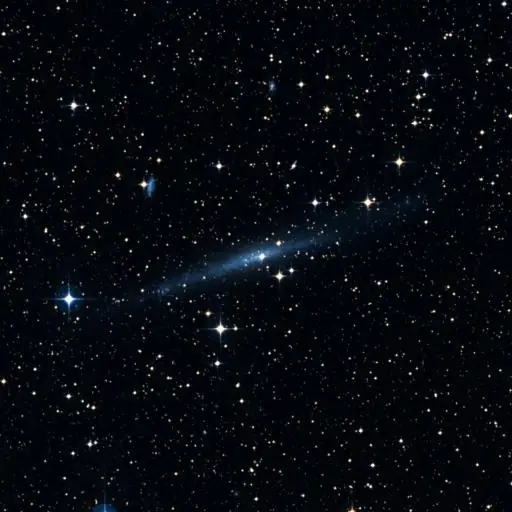
A razor-thin galaxy near Centaurus A that may be the shredded remains of a spiral.
In May 1970, two astronomers photographing the region around the giant galaxy Centaurus A at Cerro Tololo noticed a faint, elongated streak. Fourcade, from Argentina, and Figueroa, from Chile, named it after themselves. At first it was taken for a shred of debris from Centaurus A, but in 1978 it was shown to be a galaxy in its own right: a very thin disc, an edge-on galaxy seen almost perfectly side-on.
Fourcade-Figueroa is 14 million light-years away: the light we see from it set off about 14 million years ago, when great apes were spreading through Africa and Europe.
Did you know?
- Superthin. It is a classic ‘superthin’ galaxy, a flat disc of stars seen nearly edge-on. A compact core of dark matter may help explain how its disc stays so thin.
- A lost core?. One idea is that it is what remains of a spiral galaxy pulled apart near Centaurus A, with the spiral’s core surviving as the dwarf galaxy NGC 5237.
How big is it?
47% of the Milky Way’s width. Light itself takes 47,000 years to cross it. Shrink it to the length of a football pitch and our whole Solar System would be about the size of a red blood cell.
An 11.7-magnitude barred Magellanic spiral galaxy (SBm) in Centaurus, about 11′ × 1.5′.
When and where to see it
It is best placed in the evening sky around May, when it crosses the meridian at about 10 pm local time (around midnight in April). It can be seen from everywhere south of 44°N and never sets south of 44°S.
At its highest it stands below the horizon from 50°N, 9° up from 35°N, 44° up from the equator, 79° up from 35°S.
Facts
- Type
- Galaxy
- Constellation
- Centaurus
- Designations
- Fourcade-Figueroa
- Magnitude
- 11.7
- Apparent size
- 11′ × 1.4′
- Position
- RA 13h 34.8m, Dec −45° 33′ (J2000)
- Distance
- 14 million light-years
- Discovered
- Fourcade and Figueroa, 1970
Open AstroPilot to see when Fourcade-Figueroa is highest tonight from your location, how easy it is with your telescope or binoculars, and an eyepiece view.