ESO 121-6
ESO 121-6 is a galaxy in the constellation Pictor, magnitude 10.6 (blue), 4.2′ × 47″ across.
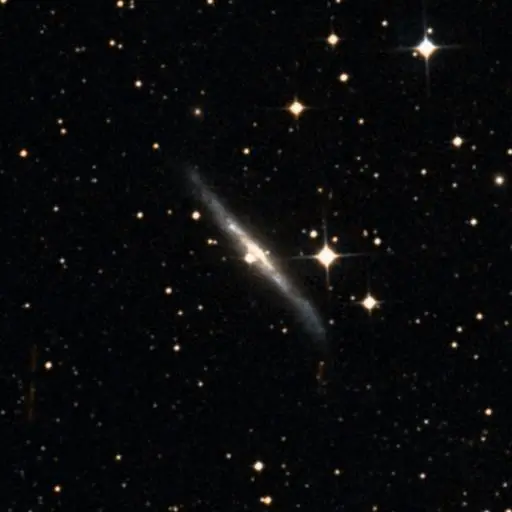
A slender spiral galaxy in Pictor, the painter’s easel, seen nearly edge-on.
Pictor began life in the 1750s as the painter’s easel, one of the constellations Nicolas-Louis de Lacaille invented to honour the tools of art and science. ESO 121-6 is one of its galaxies: an Sc spiral galaxy whose long, thin outline suggests we see it nearly edge-on. Its name comes from a survey of the southern sky made on photographic plates by the European Southern Observatory and Sweden’s Uppsala Observatory.
ESO 121-6 is 55 million light-years away: the light we see from it set off about 55 million years ago, when mammals were taking over a world without dinosaurs.
How big is it?
67% of the Milky Way’s width. Light itself takes 67,000 years to cross it. Shrink it to the length of a football pitch and our whole Solar System would be smaller than a bacterium.
A 10.6-magnitude (B-band) spiral galaxy (Sc) in Pictor, about 4.2′ × 0.8′.
When and where to see it
It is best placed in the evening sky around January, when it crosses the meridian at about 10 pm local time (around midnight in December). It can be seen from everywhere south of 28°N and never sets south of 28°S.
At its highest it stands below the horizon from 50°N, below the horizon from 35°N, 28° up from the equator, 63° up from 35°S.
Facts
- Type
- Galaxy
- Constellation
- Pictor
- Designations
- ESO 121-6
- Magnitude
- 10.6 (blue)
- Apparent size
- 4.2′ × 47″
- Position
- RA 6h 7.5m, Dec −61° 48′ (J2000)
- Distance
- 55 million light-years
Open AstroPilot to see when ESO 121-6 is highest tonight from your location, how easy it is with your telescope or binoculars, and an eyepiece view.