Coalsack Nebula (C 99)
Coalsack Nebula (C 99) is a dark nebula in the constellation Crux, 7.0° × 5.0° across.
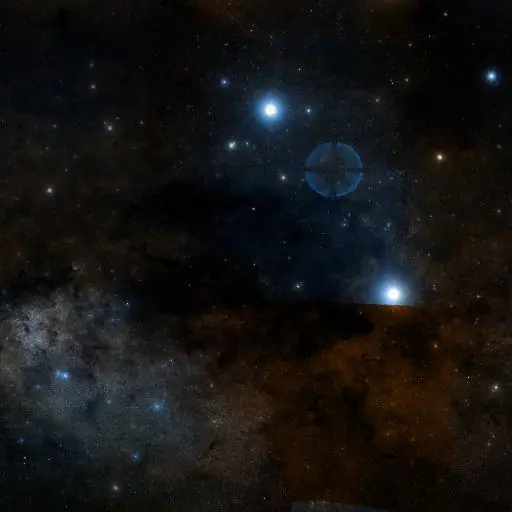
A hole in the Milky Way that Europeans called Magellan’s Spot — and Aboriginal Australians the head of the Emu.
In 1499 the Spanish explorer Vicente Yáñez Pinzón gave the first European report of a dark hole in the southern Milky Way. Amerigo Vespucci called it ‘il Canopo fosco’, the dark Canopus, and others named it Magellan’s Spot or the Black Magellanic Cloud — a dark twin to the bright Magellanic Clouds. It is a dark nebula, a vast cloud of dust blotting out the stars of the Milky Way behind it.
It had a place in other skies long before. In several Australian Aboriginal cultures it forms the head of the Emu in the sky. To the Wardaman people it is the head and shoulders of a law-man, watching to make sure people do not break traditional law. The Inca called it Yutu, after a partridge-like bird, the tinamou.
Coalsack Nebula (C 99) is 600 light-years away: the light we see from it set off around 1425, 30 years before Gutenberg printed his Bible.
Did you know?
- The Mote in God’s Eye. In Larry Niven and Jerry Pournelle’s novel The Mote in God’s Eye, a red supergiant is set against the Coalsack, and a yellow star in front of it is the ‘mote’ of the title.
- Night on the Galactic Railroad. In Kenji Miyazawa’s Japanese classic, the boy Giovanni sees only the black emptiness of the Coalsack where his friend Campanella departs for the afterlife.
How big is it?
17 times the distance from the Sun to the nearest star. Light itself takes 73 years to cross it. Shrink our Solar System — the Sun and all eight planets — to the size of a coin, and the Coalsack Nebula would be 1.85 km across (a 20-minute walk); the nearest star would be a football pitch away, and the Milky Way 2,520 km across.
The most prominent dark nebula in the sky, a dust cloud about 600 light-years away that blots out the Milky Way beside the Southern Cross; best seen with the naked eye.
When and where to see it
It is best placed in the evening sky around May, when it crosses the meridian at about 10 pm local time (around midnight in April). It can be seen from everywhere south of 28°N and never sets south of 28°S.
At its highest it stands below the horizon from 50°N, below the horizon from 35°N, 28° up from the equator, 63° up from 35°S.
Facts
- Type
- Dark nebula
- Constellation
- Crux
- Designations
- C 99
- Apparent size
- 7.0° × 5.0°
- Position
- RA 12h 50.0m, Dec −62° 30′ (J2000)
- Distance
- 600 light-years
- Discovered
- Vicente Yáñez Pinzón, 1499, First European report; long known to southern peoples
Open AstroPilot to see when Coalsack Nebula (C 99) is highest tonight from your location, how easy it is with your telescope or binoculars, and an eyepiece view.