Cave Nebula (C 9)
Cave Nebula (C 9) is an emission nebula in the constellation Cepheus, magnitude 7.7, 50′ × 30′ across.
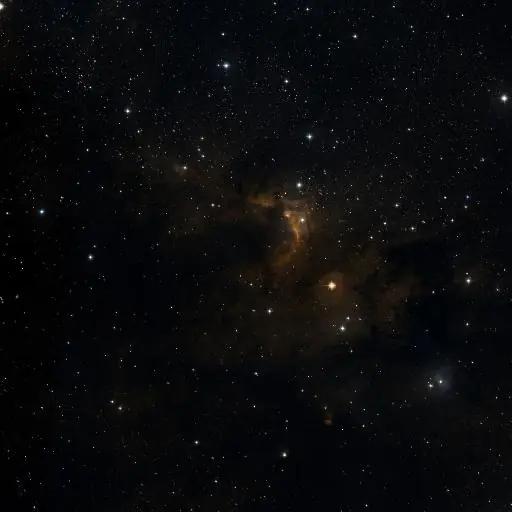
A glowing cloud where one hot young star may be squeezing gas into a new generation of stars.
Patrick Moore gave this faint cloud in Cepheus its name, probably inspired by photographs showing a curved arc of glowing gas like the mouth of a cave. He made it number 9 in his Caldwell catalogue, and the name ‘Cave Nebula’ has stuck to it ever since.
It is an emission nebula: hydrogen gas made to shine by the fierce light of young stars from a family called Cepheus OB3. It sits at the edge of a dark molecular cloud, Cepheus B. One of those stars, the hot O-type star HD 217086, may be compressing that cloud and triggering the birth of a new generation of stars. X-ray and infrared studies with Chandra and Spitzer found a progression of stellar ages in front of the cloud — just what that idea predicts.
Cave Nebula (C 9) is 2,700 light-years away: the light we see from it set off around 680 BC, around the time the first recorded Olympic Games were held.
Did you know?
- A borrowed name. ‘Cave Nebula’ was first used for a different object, Ced 201, a brighter reflection nebula elsewhere in Cepheus. The SIMBAD database still gives the name to Ced 201, not to this one.
- Catalogued in 1959. It was first listed as an emission nebula in 1959, in the expanded second edition of Stewart Sharpless’s catalogue of glowing hydrogen clouds — hence its other name, Sh 2-155.
How big is it?
9.3 times the distance from the Sun to the nearest star. Light itself takes 39 years to cross it. Shrink our Solar System — the Sun and all eight planets — to the size of a coin, and the Cave Nebula would be 991 m across (9 football pitches end to end); the nearest star would be a football pitch away, and the Milky Way 2,520 km across.
A faint emission nebula in Cepheus with a dark 'cave mouth' along one side; it needs dark skies and a UHC filter.
When and where to see it
It is best placed in the evening sky around October, when it crosses the meridian at about 10 pm local time (around midnight in September). It can be seen from everywhere north of 27°S and never sets north of 27°N.
At its highest it stands 77° up from 50°N, 62° up from 35°N, 27° up from the equator, below the horizon from 35°S.
Facts
- Type
- Emission nebula
- Constellation
- Cepheus
- Designations
- C 9, Sh2-155
- Magnitude
- 7.7
- Apparent size
- 50′ × 30′
- Position
- RA 22h 57.9m, Dec +62° 31′ (J2000)
- Distance
- 2,700 light-years
- Discovered
- Stewart Sharpless, 1959, First catalogued as an emission nebula
Open AstroPilot to see when Cave Nebula (C 9) is highest tonight from your location, how easy it is with your telescope or binoculars, and an eyepiece view.