Hyades (C 41)
Hyades (C 41) is an open cluster in the constellation Taurus, magnitude 0.5, 5.5° across.
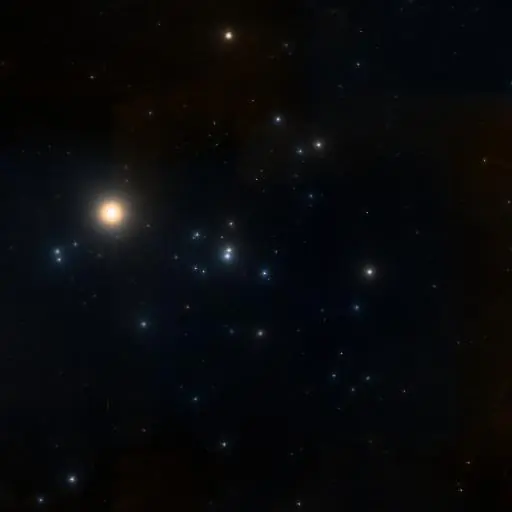
The weeping sisters of Greek myth, on the shield of Achilles — and a ruler for measuring the cosmos.
In Greek myth the Hyades were five daughters of Atlas and half-sisters of the Pleiades. When their brother Hyas died, they wept so much that they were turned into stars, forever linked with rain. In England the cluster was known as the ‘April Rainers’. Homer placed them on the shield that the god Hephaistos made for Achilles in the Iliad.
This open cluster was born from a single cloud about 625 million years ago. Its five brightest members have used up the hydrogen in their cores and swollen into giants, and eight white dwarfs in its core mark heavier siblings that have already died. Most clusters break up within 50 million years. The Hyades has survived, but it is slowly evaporating: about a third of its known members lie in a halo beyond its gravitational edge, probably escaping.
Hyades (C 41) is 150 light-years away: the light we see from it set off around 1875, around the time Edison lit his first practical light bulb — the start of light pollution.
Did you know?
- A cosmic ruler. The Hyades are close enough to measure directly by parallax, as Hipparcos and Hubble have done. Other methods agree, making the cluster a key rung on the ladder used to measure distances to other galaxies.
- First planet in a cluster. Epsilon Tauri, known as Ain, the ‘Bull’s Eye’, has a giant planet candidate — the first planet found in any open cluster.
- Long-lost sibling. The Hyades and the Praesepe cluster, M 44, share their age, chemistry and motion, and their paths trace back to the same region of space. They were probably born together.
How big is it?
Born about 630 million years ago, when there were no animals on Earth at all. Light itself takes 14 years to cross it. Gaia has picked out 927 stars moving together through space as its members. That’s 3.4 times the distance from the Sun to the nearest star. Shrink our Solar System — the Sun and all eight planets — to the size of a coin, and the Hyades would be 362 m across (3 football pitches end to end); the nearest star would be a football pitch away, and the Milky Way 2,520 km across.
The nearest open cluster to the Sun, about 150 light-years away, forming the V-shaped face of Taurus. Orange Aldebaran lies in front of it but is not a member.
When and where to see it
It is best placed in the evening sky around December, when it crosses the meridian at about 10 pm local time (around midnight in December). It can be seen from everywhere north of 74°S and never sets north of 74°N.
At its highest it stands 56° up from 50°N, 71° up from 35°N, 74° up from the equator, 39° up from 35°S.
Facts
- Type
- Open cluster
- Constellation
- Taurus
- Designations
- C 41, Cr 50, Mel 25, Collinder 50, Melotte 25
- Magnitude
- 0.5
- Apparent size
- 5.5°
- Position
- RA 4h 26.9m, Dec +15° 52′ (J2000)
- Distance
- 150 light-years
- Discovered
- Known since prehistoric times; probably first catalogued by Hodierna in 1654
Open AstroPilot to see when Hyades (C 41) is highest tonight from your location, how easy it is with your telescope or binoculars, and an eyepiece view.