Double Cluster (C 14)
Double Cluster (C 14) is an open cluster in the constellation Perseus, magnitude 4.0, 50′ × 50′ across.
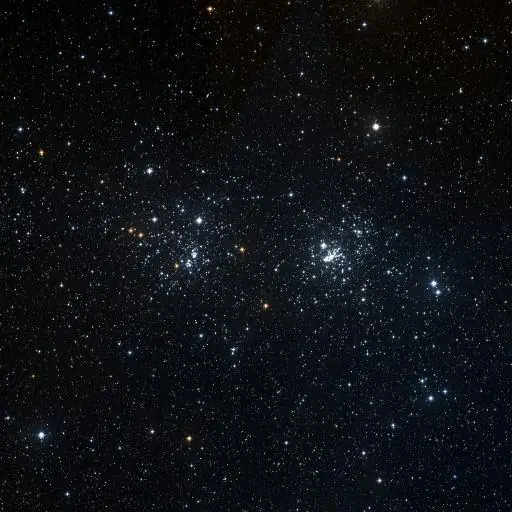
Two young star clusters side by side — the jewelled hilt of Perseus’s sword, recorded since ancient Greece.
In Greek myth, Perseus holds Medusa’s head in one hand and a sword in the other, and this pair of clusters marks the sword’s jewelled handle. Hipparchus catalogued the glow as early as 130 BC. To Bedouin Arabs it was the tail of a small fish, and it appears in al-Sufi’s Book of Fixed Stars. Only telescopes showed what it really is: two separate open clusters, NGC 869 and NGC 884, still known by their old star-like names h and χ Persei.
Both clusters are young — about 14 million years old, several times younger than the Pleiades — and full of hot blue-white stars. They lie in the Perseus Arm of our galaxy and form the heart of the Perseus OB1 association, a wider family of young, hot stars.
Double Cluster (C 14) is 7,500 light-years away: the light we see from it set off around 5480 BC, around the time the first towns were growing in the Fertile Crescent.
Did you know?
- Red giants among the blue. NGC 884 holds five red supergiants — RS, AD, FZ, V403 and V439 Persei — and all of them are variable stars, slowly changing in brightness.
- Home of the Perseids. The Double Cluster lies close to the radiant of the Perseid meteor shower, the point from which August’s shooting stars appear to stream each year.
- Heading our way. Both clusters are approaching us, at about 38 and 39 kilometres per second.
How big is it?
Born about 14 million years ago, when great apes were spreading through Africa and Europe. Light itself takes 109 years to cross it. That’s 26 times the distance from the Sun to the nearest star. Shrink our Solar System — the Sun and all eight planets — to the size of a coin, and the Double Cluster would be 2.75 km across (a 35-minute walk); the nearest star would be a football pitch away, and the Milky Way 2,520 km across.
Two bright open clusters, NGC 869 and NGC 884, side by side in the same low-power field. Visible to the naked eye as a hazy patch between Perseus and Cassiopeia, they are among the finest sights for binoculars.
When and where to see it
It is best placed in the evening sky around November, when it crosses the meridian at about 10 pm local time (around midnight in October). It can be seen from everywhere north of 33°S and never sets north of 33°N.
At its highest it stands 83° up from 50°N, 68° up from 35°N, 33° up from the equator, below the horizon from 35°S.
Facts
- Type
- Open cluster
- Constellation
- Perseus
- Designations
- C 14, h & Chi Persei, h & χ Persei
- Magnitude
- 4.0
- Apparent size
- 50′ × 50′
- Position
- RA 2h 20.7m, Dec +57° 8′ (J2000)
- Distance
- 7,500 light-years
- Discovered
- Hipparchus, Catalogued by Hipparchus as early as 130 BC
Open AstroPilot to see when Double Cluster (C 14) is highest tonight from your location, how easy it is with your telescope or binoculars, and an eyepiece view.