Horsehead Nebula (B 33)
Horsehead Nebula (B 33) is a dark nebula in the constellation Orion, 6.0′ × 4.0′ across.
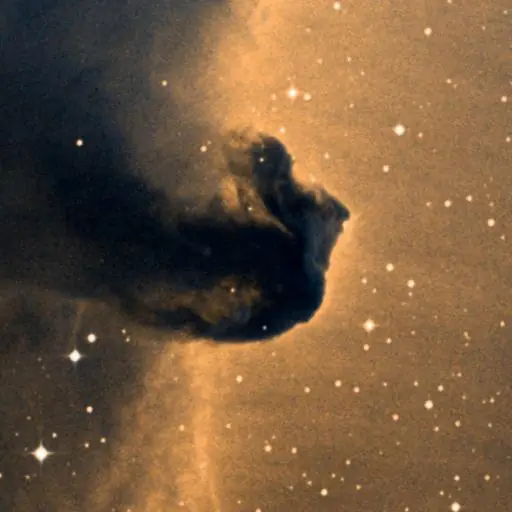
The most famous dark nebula of all: a cold cloud of dust shaped like a horse’s head, found on a Harvard photograph.
In 1888 Williamina Fleming — a former maid who became one of Harvard College Observatory’s leading astronomers — spotted the Horsehead on a photographic plate. It is a dark nebula, a dense cloud of cold gas and dust that blocks the light behind it. The horse’s head rises from a larger dark cloud and is silhouetted against the red glow of IC 434, an emission nebula.
It is not empty. Bright spots at its base are young stars still forming, and the whole cloud is part of the vast Orion molecular cloud complex.
Horsehead Nebula (B 33) is 1,400 light-years away: the light we see from it set off around AD 630, 90 years after the Hagia Sophia was completed in Constantinople.
Did you know?
- Named after Horace Hedd?. In Isaac Asimov’s 1951 novel The Stars, Like Dust, a character raised on another planet insists the nebula was named after Horace Hedd, the first man to enter it.
- Barnard 33. E. E. Barnard listed it as number 33 in his catalogue of dark nebulae, describing a dark mass on a nebulous strip south of Zeta Orionis.
How big is it?
2,570 Solar Systems side by side. Light itself takes 2.4 years to cross it. Shrink our Solar System — the Sun and all eight planets — to the size of a coin, and the Horsehead Nebula would be 61.7 m across (about the length of an Olympic pool); the nearest star would be a football pitch away, and the Milky Way 2,520 km across.
An iconic dark nebula shaped like a horse's head, silhouetted against the glowing IC 434. A challenge needing dark skies; an H-beta filter helps (OIII filters do not).
When and where to see it
It is best placed in the evening sky around January, when it crosses the meridian at about 10 pm local time (around midnight in December). It can be seen from everywhere south of 88°N and never sets south of 88°S.
At its highest it stands 38° up from 50°N, 53° up from 35°N, 88° up from the equator, 57° up from 35°S.
Facts
- Type
- Dark nebula
- Constellation
- Orion
- Designations
- B 33
- Apparent size
- 6.0′ × 4.0′
- Position
- RA 5h 41.0m, Dec −2° 27′ (J2000)
- Distance
- 1,400 light-years
- Discovered
- Williamina Fleming, 1888
Open AstroPilot to see when Horsehead Nebula (B 33) is highest tonight from your location, how easy it is with your telescope or binoculars, and an eyepiece view.