61 Cygni
61 Cygni is a double star in the constellation Cygnus, magnitude 5.3.
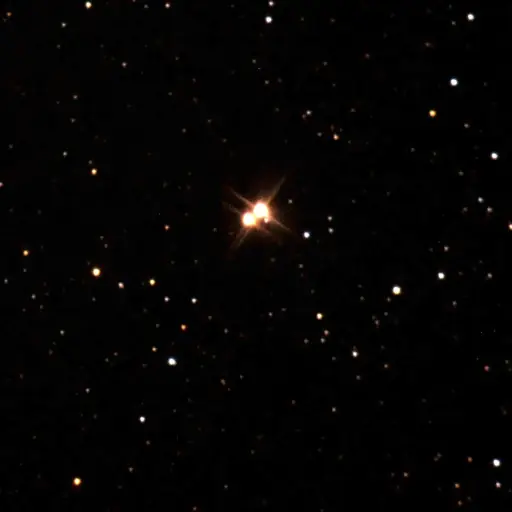
Piazzi’s “Flying Star” — the fastest-moving star you can see with the naked eye, and a landmark of astronomy.
Most stars hold their places for centuries; this one flies. In 1792 Giuseppe Piazzi compared his measurements of a faint star in Cygnus with James Bradley’s from 40 years earlier, and found it had shifted. No other naked-eye star crosses our sky so quickly. Piazzi dubbed it the “Flying Star” and suggested that anything moving so fast must be near — a prime target for measuring a star’s distance.
Attempt after attempt failed: the errors were bigger than the effect. Then Friedrich Bessel, using a new heliometer by Joseph von Fraunhofer, measured its tiny yearly shift from Königsberg in 1837–38. It was the first reliable distance to any star beyond the Sun, published just ahead of Struve’s result for Vega and Thomas Henderson’s for Alpha Centauri.
What he measured is a double star of two small orange dwarfs, cooler, dimmer and older than the Sun, circling each other every 659 years or so. Over the twentieth century several astronomers claimed a giant planet here; better measurements showed every claim was unfounded.
61 Cygni is 11.4 light-years away: the light we see from it set off in 2015, 6 years before the James Webb Space Telescope was launched.
Did you know?
- A coin from 13 kilometres. Bessel’s parallax was about a third of an arcsecond — roughly the apparent width of a 2-centimetre coin seen from 13 kilometres away.
- An anchor for the stars. 61 Cygni A is so steady that it serves as an “anchor star” in the Morgan–Keenan system, the standard scheme for classifying stars by their spectra.
- Still coming closer. 61 Cygni is approaching us. Its closest pass to the Sun will come around the year 20,000.
How big is it?
Smaller than the Sun: 67% of its width. Its main star is about 930,000 km across. It gives off 15% of the Sun’s light. It has 68% of the Sun’s mass. Its companion star is at least 112 times Earth’s distance from the Sun away — 3.7 times as far as Neptune is from the Sun.
A pair of orange dwarfs about 11.4 light-years away; 61 Cygni was the first star to have its distance measured (Bessel, 1838). Its components (magnitudes 5.3 and 6.1; spectral types K5 V (orange) and K7 V (orange)) lie 32″ apart at PA 154° (measured 2025).
When and where to see it
It is best placed in the evening sky around September, when it crosses the meridian at about 10 pm local time (around midnight in August). It can be seen from everywhere north of 51°S and never sets north of 51°N.
At its highest it stands 79° up from 50°N, 86° up from 35°N, 51° up from the equator, 16° up from 35°S.
Facts
- Type
- Double star
- Constellation
- Cygnus
- Designations
- 61 Cyg, STF 2758, HIP 104214
- Magnitude
- 5.3
- Position
- RA 21h 6.9m, Dec +38° 45′ (J2000)
- Distance
- 11.4 light-years
- Discovered
- Catalogued by Flamsteed; first seen as a double by James Bradley in 1753
Open AstroPilot to see when 61 Cygni is highest tonight from your location, how easy it is with your telescope or binoculars, and an eyepiece view.